
Lists

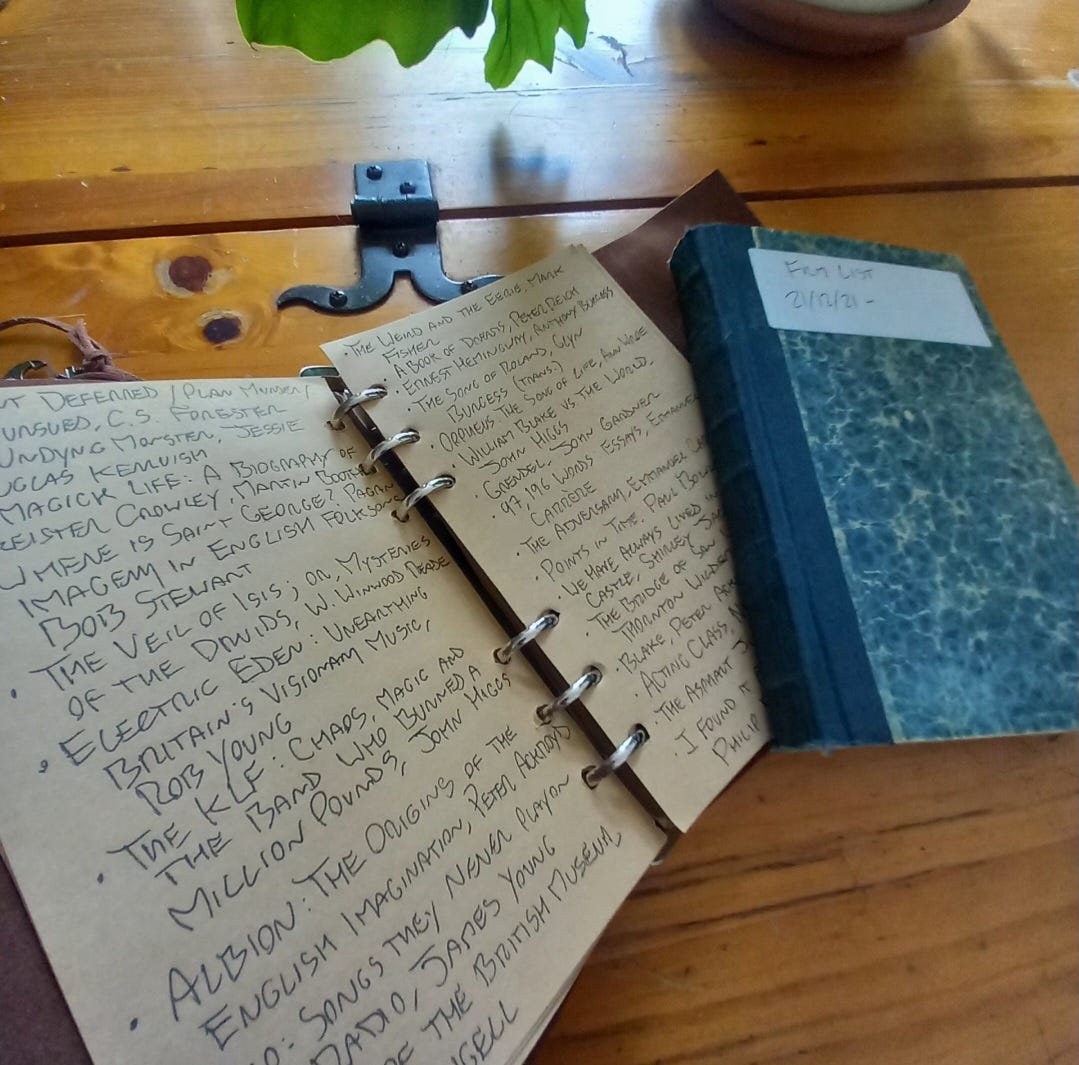
Since October 2024, the month of my forty-eighth birthday, I’ve been keeping a list of books I’ve read. The last time I attempted a log of this kind was around ten years ago, with each book getting its own mini review, but I soon grew tired of that because why would I want to read my own thoughts on a book when someone else’s review could offer something more enlightening or have me cursing the reviewer’s name for being so stupid as to not like the same things I do. So, the reason I started doing this again was because I realised that my reading habits had grown proportionately over the past few years; since I went back to full time education, in fact, in my late thirties, to study English literature, a period which coincided with me running my first bookshop. I suddenly found books being forced upon me at an alarming rate, resulting in the sacrifice of one book in favour of another, with me choosing to drop an author, series or subject if I found my mind wandering, which it’s prone to do. Those sacrificed on the altar of mild amnesia have included Ian Rankin’s Rebus series (three books in), Terry Pratchett’s Discworld (I gave up after Mort), Kafka (I don’t get the appeal), and, well, a load of other stuff that I’ve forgotten because they didn’t make the list.
Plus, I like lists. They’re easy to digest points of reference that I can return to once a recommended title has vacated my memory in the time it’s taken for another to be enthusiastically shoved into my hands. I like movie guides (cult movie guides especially), because I can trace my finger down the titles, stopping at some outlandish obscurity that I’d be a fool not to explore. More often than not they turn out to be dreadful, but as Steve Coogan’s second funniest creation Paul Calf once put it, “In every bag of shite there’s a spark of gold. It’ll probably turn out to be the wrapper off a Caramac, but it’s there.” Now, I’d hate to have missed out on these sparks of gold, and without a handy list to refer to, chances are I probably would have, bullion or otherwise.
I usually start a book by flipping to the back and checking out the index and bibliography, and then returning to it and making a list of the books on there that I may want to read myself some day. Electric Eden, Rob Young’s superb exploration of British folk music, has one of the best bibliographies I’ve come across. It also includes an excellent chronological discography of the acts covered, so you can either listen to the music develop in the order it was produced or, like me, skip some of the field recordings about a sailor’s sister and her promiscuous ways to get to the Trees records.
I only have four books of lists, which isn’t that many. Reading takes up most of my time so the one I open most is the one titled ‘Books I’ve Read’. Fairly self-explanatory. Just the book and the author, no publisher nor date of publication, and definitely no armchair review or star rating. On the first page is a heading: ‘Notable Books I’ve Read Since I Turned 48 Years Old Around September-October’ (my memory isn’t so bad yet that I don’t know which month I was born. When I started on this list I remembered some cracking books I’d read in September that it would have been a shame to exclude; tracing back further, I would have liked to have included Thomas Ligotti’s collections Songs of a Dead Dreamer and Grimscribe. Ditto Laid Barron’s The Imago Sequence and Occultation. But then where would it end, or begin?)
There’s one rule of the ‘Books I’ve Read’ list: I have to have read them cover to cover. That includes short story collections. I log the short story collections thus: if it’s a collection, by, say, Jorge Luis Borges, I’ll pop an asterisk next to the author’s name which will direct me to the back of my book of lists where I’ll find the title and author repeated along with the titles of the stories included. Similarly, if it’s an anthology like, say, one of the Tales of the Weird paperbacks published by the British Library, I’ll list the title and the editor followed again by an asterisk which tells me that the stories’ individual titles and their respective authors can also be found at the back of the book. The back of the book also has some stories by authors like Arthur Machen, H.P. Lovecraft and R.L. Stevenson, whose stories have been anthologised or collected in various editions with many a cross-over. The problem with the cover-to-cover rule is that, in the case of short story collections, it can become a little laborious, especially when anthologies insist on including oft-repeated tales ad nauseum. That reminds me: Such Stuff As Screams Are Made Of by Robert Bloch would have been a fine addition, but I read that particular vintage sometime before September 2024.
The cover-to-cover rule is very important. If I find myself turning pages without fully taking in their contents, it’s a sure sign of either (a) tiredness, in which case I’ll give the book my full attention the next day, or (b) something wholly unengaging or, flying headlong in the face of popular opinion, woefully unfunny (stand up again, if you will, Kafka and Pratchett). I’m at an age now when I have absolutely no feelings of guilt, abandonment, or defeatism when I take the decision to give up on a book. I used to have to finish a book once I’d started it, but I now realise with total clarity that this could lead to a hellish week like the one I spent praying for The Tommyknockers to Please. Fucking. End.
My second notebook holds my list of ‘Films Watched’. This one I’ve kept since I closed my Instagram account filled with, what I thought, were witty and insightful reviews of lesser know films. I think it was Philip Roth who said something along the lines of wasting his time writing when he could have been reading. I took this on board, replaced ‘reading’ with ‘watching’, stopped posting self-indulgent reviews that nobody read anyway and transferred all the films I’d watched into a handy list: Title. Director. Year. This list dates back to 2021. That’s a lot of films. A lot of Scorsese, Bunuel, Carpenter, Bava and De Palma, but also a smorgasbord of top grade schlock by the likes of Larry Cohen and Stuart Gordon (come to think of it, should De Palma be in the top grade schlock too? Sure. Why not.)
My latest book of lists concerns comics read. This list is more detailed: Series title, issue number(s), date(s), writer and artist, and, if necessary, story arc. I started this one in Spring this year after reading two books: The Amazing Adventures of Kavalier and Clay by Michael Chabon and All the Marvels by Douglas Wolk. Two good books. The first a Pulitzer prize winning fictionalised account of the pioneers of the comic book industry, namely Stan Lee and Jack Kirby, but under different names. The second a reassuring guide to reading Marvel comics (who knew? I don’t have to read everything from the beginning to understand the MCU, though I did anyway, thanks to a few collections of early Lee and Kirby stories from my local library that included issues #1-20 of Fantastic Four, The Avengers, and The Amazing Spider-Man, and issues #1-6 of The Incredible Hulk. It’s been a small thrill to see these iconic characters punching their way through their formative years, and though the flow of repetition can get a little laboured at times (Peter Parker is anxious about his Aunt May’s health, girls, school work, has a fight with a masked villain, takes a lot of abuse from J. Jonah Jameson, etc etc.), it’s proving to be an energetic and hugely entertaining dig around in the fertile ground that later writers would add their own stylistic and narrative takes to. Luckily, I have an omnibus edition of the complete Fabulous Furry Freak Brothers, assorted Superman stories, and Frank Miller’s run on Daredevil to break the flow of repetition when needed.
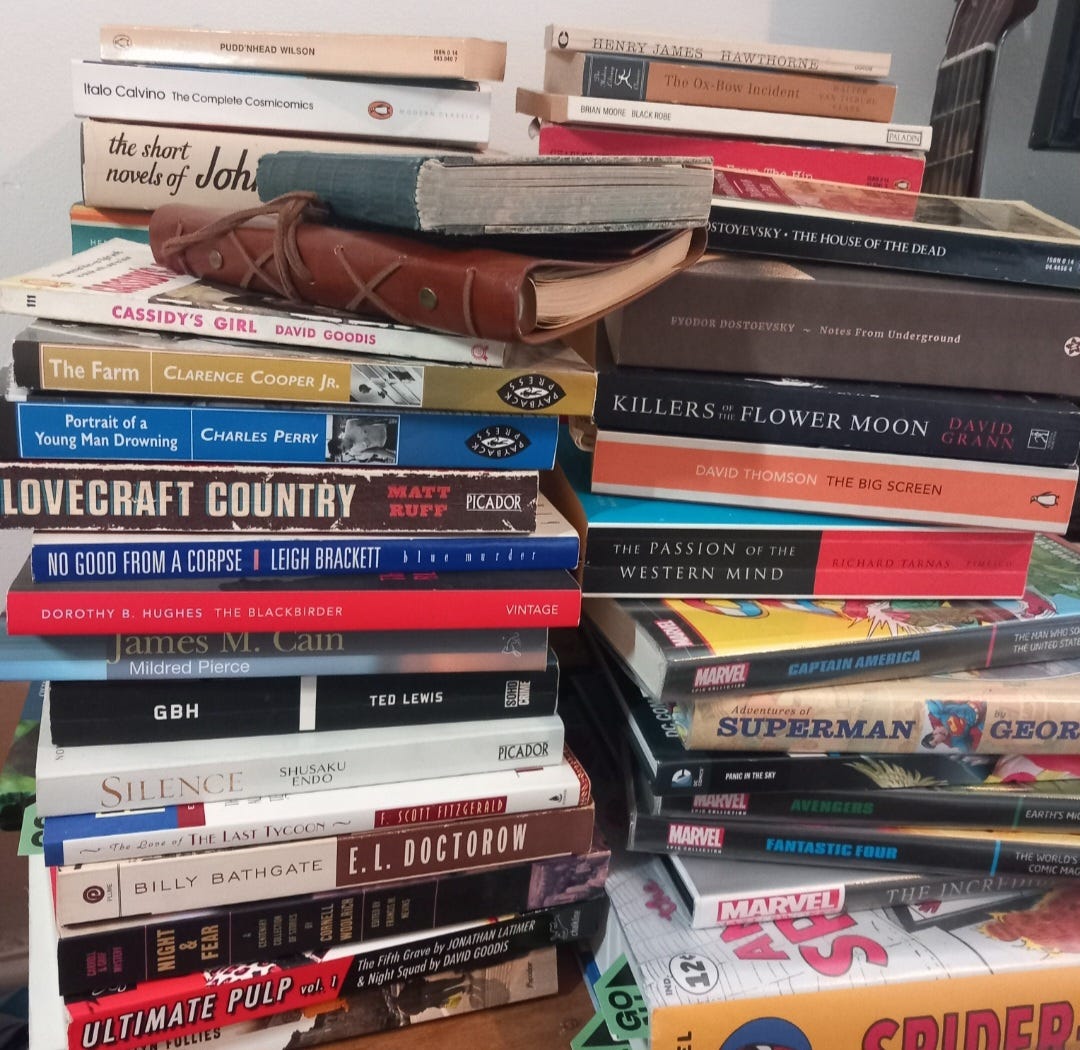
One last list (if you’re still with me): ‘Books I Want to Read’. This is a natural progression of the bibliographies I like to paw over, but also stems from more recommendations from various well read sorts who occasionally squeeeeze themselves comfortably into my little literary bubble, cosy up beside me and say: “If you like hardboiled crime fiction (I do) then try GBH by Ted Lewis (which I found in Oxfam, Manchester the very next week), accompanied by The Seaside by Madeleine Bunting; two books I should have taken with me on a trip to Mablethorpe instead of Ride the Pink Horse by Dorothy B. Hughes, itself a worthy novel, though I felt novella length would have improved it enough to stand shoulder-to-shoulder with her masterworks In a Lonely Place and The Expendable Man. Briefly, on the subject of good crime fiction you won’t find in the 3-for-1 deals in Morrisons, this morning’s mail brought me Hardboiled America: Lurid Paperbacks and the Masters of Noir by Geoffrey O’Brien which, I am happy to share, includes a fantastic bibliography and a list of essential hardboiled crime novels which will promptly be added to the ‘Books I Want to Read’ list. Oh, here’s my bedside reading pile as it stands.
And in the end, what’s the point of all this listing? Well, I suppose there isn’t one. Except in years to come I’ll be able to look back and see how my reading tastes shifted from one month to the next. Arthurian tales, fables and mythology of the British Isles one month, a shift of gear into more contemporary fare like John Higgs’ books on The KLF and William Blake, or novels from the canon like Frankenstein, Watership Down, and Alice in Wonderland (all first time reads, would you believe?) The end result is around 170 books read since October 2024, including Marvel and DC collections or graphic novels, which can be divvied up into over 200 comics read since the Spring. But where does it end? Do I also list every essay and review I’ve read because Pauline Kael’s reviews of M*A*S*H, Stop Making Sense, and Band of Outsiders also achieve literary greatness in the same way Elena Lappin’s Granta piece on literary fraudster Binjamin Wilkomirski does? Erm, maybe. But while I’m pondering this, I’m going to stop wasting time writing when what I should be doing is tackling that reading pile.